When he went to prison at thirty years old, Al’s eyes were opened to the realities of incarceration. Enduring a prison lockdown that lasted almost two months, he lived through an agonising 52 days in solitary confinement…
But on day 32, Al met God.
“I was at the lowest point in my life when I went inside,” says Al, who describes himself at the time as agnostic, and before that, a “full-blown atheist”. In trouble with the law for the first time in his life, he was looking at 10 years behind bars. “I hadn’t broken mentally yet, but I was stuck on the train tracks. I could see that train coming, and I didn’t know what to do.”
“Throughout my life, I had been getting very clear signs [from God], even relating to my crime. I would hear a voice that would whisper: ‘You should get rid of those guns. Say no, get them out of there.’ But I played it off, attributing it to my imagination or conscience.”
‘Playing it off’ led to Al’s arrest. “I met many prison officers who were surprised it was my first time. They expected me to know what to do, and they were almost confused when I was confused. It was like, of course I’m confused! This is scary, this is all foreign to me. If you’re not used to it, if you’ve spent years and years of life not committing a crime, and then suddenly you’re in this system, it’s very jarring. Even though I was guilty.”
Not long after he arrived, an extended COVID lockdown hit Al’s prison. He was put into solitary confinement for what ended up being almost two months. “Imagine being locked in your bathroom and being fed through the wall,” he says.
For 52 days, Al had no proper human contact.
“On day 32, I didn’t know how much longer I could take it. The illusion of the control I thought I had over my life finally broke…”
“I got down on my knees like I had seen in the movies. I put my hands in a little prayer position over the bed. I didn’t really know what to do, I was crying… but I decided to speak to God as if He were real.”
“I didn’t realise what I was doing, but I was repenting. I begged for forgiveness. I said, ‘I’m sorry for everything, for how selfish I’ve been and how much I ignored the signs this was coming. Please forgive me. I don’t know how I’m going to do this. Please just help me through this.’”
“Words started failing. I was crying in a cell all by myself. And then I distinctly felt a hand on my right shoulder.”
“I know what a hallucination is. I’ve taken psychedelic drugs before. This was not a hallucination. I felt an incredible, indescribable rush. It was as if the purest love was also light and water and it just rushed through my entire body. I felt completely reassured. I felt loved. I felt wanted. I felt like I was meant to know it would be okay. It was like this floodgate opened inside me, and all the yucky stuff I had been holding on to just washed away.”
When he woke up the next morning, that reassurance remained. Making it through lockdown, Al received bail and went to trial. “It was just good news after good news. Instead of the 10 years I could have been given, I ended up doing 13 months…“
“I was seeing this incredibly unlikely mercy being played out. On the day of my trial, I finally admitted to myself what I knew deep down – that Jesus Christ was who He said He was. I said to Him, ‘It was you. And I’m here to give my life to you.’”
INTO THE GAP
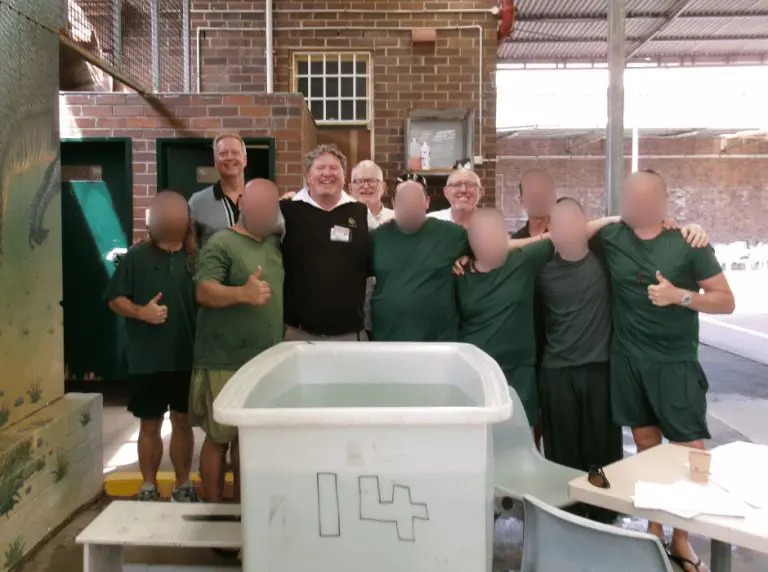
Inside prison, Al signed up for a number of programs, one of which was Prison Fellowship’s character-development course, Change on the Inside. It was here Al met Keith.
“Keith was a Prison Fellowship volunteer. From the get-go, his attitude was so caring. When he would talk to you, it was like he was saying, ‘Of course I’m here. Of course I’m here to help. Of course I’m here to listen to you.’ It was like he didn’t know a different way to be, or to see me – even as an inmate. He wasn’t trying to preach or convert anyone. He didn’t judge you. He just… was there. Week after week. Month after month.”
“Volunteers like Keith fill a big blind spot in the Australian prison system. When you’re thrust into that environment, there’s no real means of connecting with other people more generally. Prisoners and prison officers don’t talk to each other in any extended manner. It can be courteous, but it’s frowned upon to talk beyond what’s necessary.”
“There are reasons for that. From the officers’ point of view, there are issues of corruption, that sort of thing. But the real driving force is the criminal instinct against ‘snitches’, for lack of a better word. It’s suspicious to talk to officers excessively. That means you could have an officer with a PhD in Social Work and they’re not necessarily going to get anywhere. You could have incredibly well-trained, well-meaning officers… but with the current culture, that’s not going to make much of a difference. Their ability to help ‘rehabilitate’ or have a positive influence is hampered by their role as prison guards. So, as an inmate, what you’re left with is socialising with people who are quite likely more ‘hardened’ or more severe criminals than you.”
“What that leaves is this big, wide, yawning gap for prisoners who don’t have any positive influences in their lives – and often haven’t from a very young age. But it’s into that gap where Prison Fellowship comes in. Keith, he could wander just about anywhere, talk to anyone. I could talk to him for as long as I wanted, and I never had any issues. No one looked at us twice.“
“He’s a person who cares, and that’s it. There’s no ulterior motive, no intelligence gathering incentive. That means prisoners can relax and actually have that positive interaction. It’s not necessarily going to be a silver bullet, but it is one of dozens of things which, together, can really build someone up to have a much better chance at rehabilitation. Without that role being fulfilled, you’ll get even more people falling into the gaps. You’ll get a higher recidivism rate, and you’ll get higher recidivism severity as well.”
Al says that Change on the Inside helped give him a solid and practical, day-to-day moral framework. “I used to be very abstract in my thinking, into philosophy. Some of those ideas can be interesting, but they can’t necessarily help you in your day-to-day life – like guiding you on how you should treat other people, treat your family, or even yourself. It made me think about things like, ‘What does it mean to be a man?’ At the time, I had two children under 10. So what does it mean to be a responsible man… a father, friend, brother, or son?”

Keith, who has been a prison ministry volunteer for close to 16 years, remembers meeting Al: “Before I start a course,” he says, “I like to have an information session that essentially tries to talk people out of it, unless they’re really prepared to look internally. If someone is coming merely to make a parole application look better or because their case manager said to, I’d rather they not come. They have to be motivated; prepared to make changes. It quickly became clear to me that Al was seriously committed to looking internally and to making changes.”
“Change on the Inside is about looking beneath the surface, understanding what makes you tick. It’s not primarily about behaviour. It’s about giving people choices. Most people have picked up their values and beliefs by osmosis, without even realising. Change on the Inside helps you understand yourself, your values and your beliefs so that, ultimately, you can make choices about which ones you continue with and which ones you don’t.”
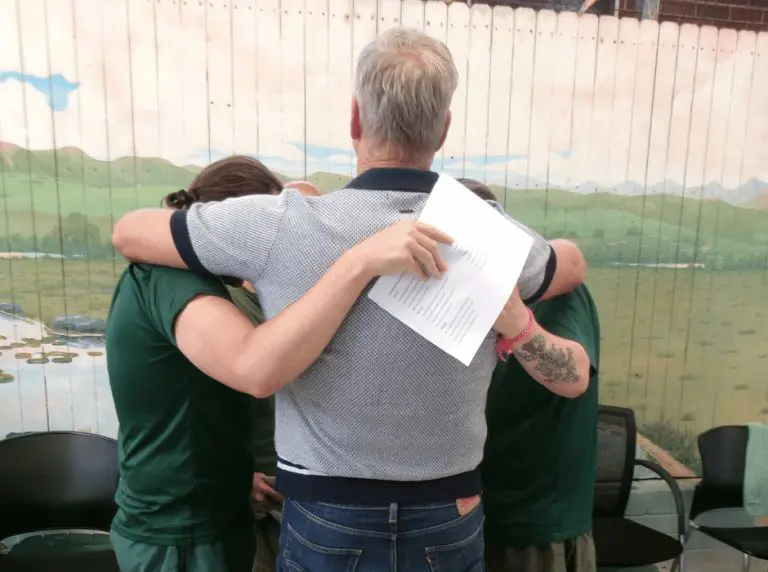
In the last session of the course, the men give a two-minute talk on ‘the kind of man I want to be’. “It’s a very moving experience,” says Keith. “It’s an incredible privilege to hear them talk about that.”
“I usually try to follow up with participants after the program to see how they are going. Al was welcoming of that. I was really pleased to spend time with him. I was thankful for his genuineness and his heart. Al is an impressive young man, intelligent and articulate.”
“I’ve found that there’s often not much difference between people in green [inmate uniforms] and people who aren’t in green,” Keith continues.
“There’s a lot of good you find in people inside. In prison ministry, you want to bring that out and encourage them in those traits. For some prisoners, it’s a bit of a surprise that anyone would bother with them, but I think it’s very much a demonstration of God’s love to do that.”
Al echoes a similar sentiment. “Having just come into a relationship with God, I wasn’t really sure what that was going to look like long-term,” he says. “Keith, he’s been a Christian for a long time. It was nice to have a model of what that could look like. To see that, if you have faith, you can have this really beautiful life worth living that you can share with people and use to help others. It was one of my first relationships that was connected to the ‘vine’, to the church.”

THE CHURCH AL NEEDED
After serving his sentence, Al left prison. “I was asking myself, ‘Where can I go to church?’ Then one day I was on my balcony and saw a church steeple. I thought, ‘That’s exactly where I should be.’”
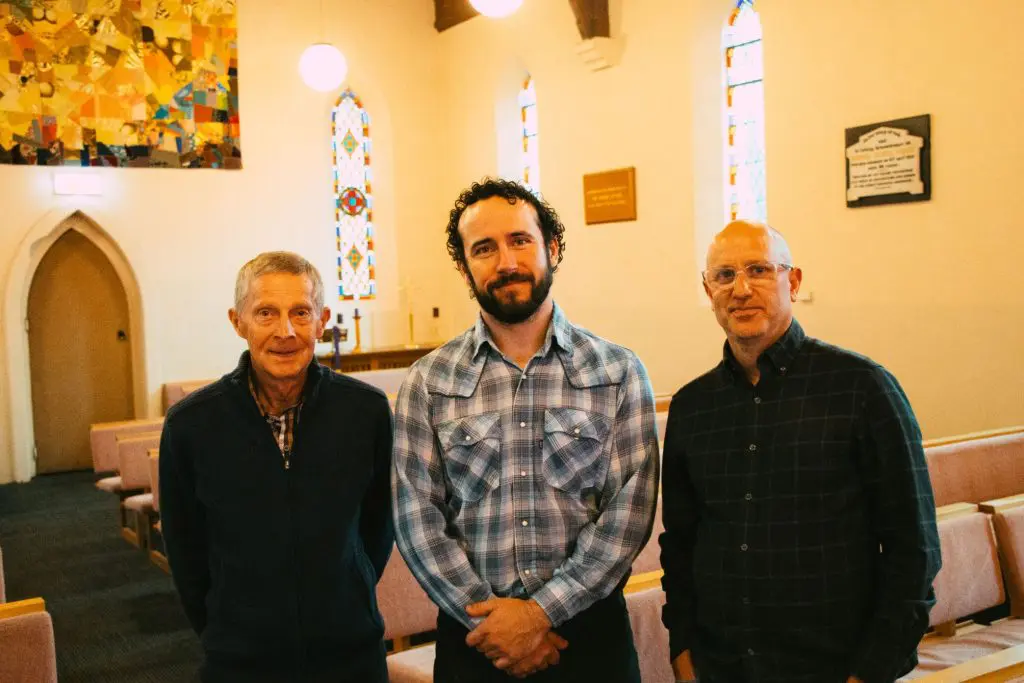
That church is led by Pastor Tim, who remembers first meeting Al in early 2025. “It was January when Al turned up,” says Tim. “He was very open about the fact he’d been in prison, there was no hiding. A number of people welcomed him and chatted to him, and I was able to meet him that day.”
“He’s hardly missed a Sunday since he first came. His experience meeting God in prison was very real and very tangible. He gave his testimony at one of our services, and you could hear a pin drop. It was powerful and moving for our congregation. He again shared at an Alpha course we were running, encouraging others who were exploring God. He’s been very willing – he helps set up and pack up dinners and so on. He is definitely a part of the life of the church here.”
Al shares: “I like getting to know people and being a supportive member of the community. I like being there for people, like Keith was for me. I was a lonely kid. And I’ve gone from the most alone I’ve ever felt – in solitary confinement – to the least alone I’ve ever felt. I don’t just feel plugged into a community, I also feel plugged into the world. Before I felt isolated from that, but now I don’t just see all the connections, I’m part of it. And I’m happy to be part of it.”

“One of the key moments for me was a dinner at our evening service,” says Tim. “When I arrived it was in full swing. Al was there, holding a staff member’s baby. And it was just this beautiful moment of what the ‘church’ should be like. Here’s this guy who has been in prison and he’s gently holding this baby… this is exactly what church life should be like.”
“Our church has supported Prison Fellowship’s Easter Biscuit Bake and Angel Tree for a number of years. But recently we’ve signed up to also become a Restoration Hub – a church that welcomes former inmates. When I first brought that proposal to our team, the immediate response was ‘Why wouldn’t we do this?’ Church is about welcoming people in. Fellow sinners who need God’s grace.”
“Last year I received a phone call from a prison chaplain who was trying to find a church for the wife of a prisoner. She asked ‘If this woman turned up to your church, would she be welcome?’ I couldn’t believe she would need to ask! As a church, to be able to have God trust us with someone like Al to walk in, knowing that people would welcome him, that is a blessing to us. Al has been a blessing to our community.”

THE HEALTHY DON’T NEED A DOCTOR
Thinking back to prison, Al is reflective: “Prison is the epicentre of where God is needed the most. Christ didn’t come like a doctor to heal the healthy. He came to heal the sick. For me personally, the sort of ice I was skating on, between having a good, productive, wholesome life, vs falling through the ice and into a negative way, had I not encountered Prison Fellowship, that ice would have been that much thinner.”
“In prison, there are many people who have fully embraced their own sort of false identity as a ‘bad’ person. They lean into that. The thing is, they’re still human, and they still deserve the love and respect of any other human. They’re actually often the most broken and needy humans.”
“If you encountered a traumatised child who was behaving badly, you wouldn’t call them a bad person. You wouldn’t judge them or treat them harshly…these people in jail are still that same small, traumatised, damaged child. They’ve just grown up. They’re still there on the inside, and they’re hurting.”
“The good news – it’s good news for everyone,” says Tim. “Prison Fellowship meets people where they’re at. The support people give to this ministry, it’s bearing fruit in people’s lives. Al’s life is testimony to that.”

GOD IS MEETING WITH INMATES LIKE AL INSIDE PRISON. With your gift, you can help equip prison volunteers and Restoration Hub churches to be there for prisoners like Al, helping them grow in their relationship with God and walk into the futures He has for them. Donate now.