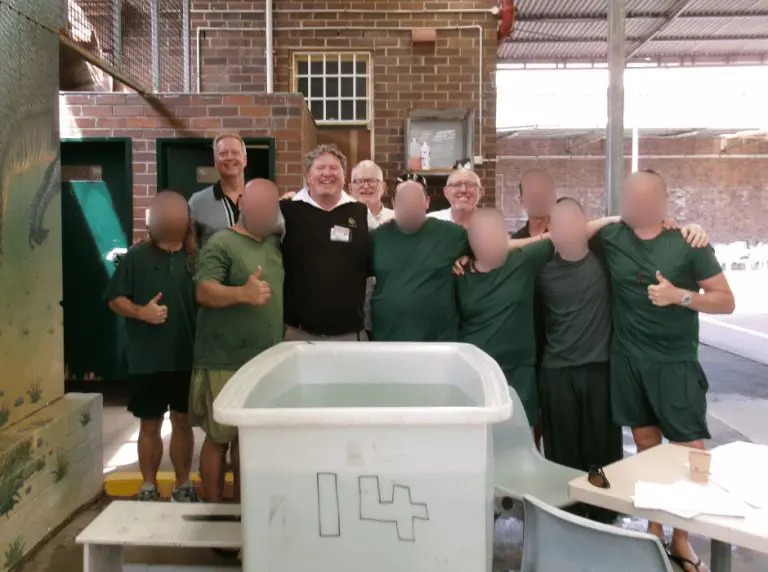
Aaron Stevens stands amongst a group of men, his eyes closed and hands raised as they lift their voices to God in a song of praise. It’s an act of worship not unfamiliar to him, but this time is different. To his left and to his right are men who have been incarcerated inside a Sydney prison – some for a couple of years, some for life. Alongside Prison Fellowship Australia, Aaron and a team from Revive church have been invited in to lead a special chapel service, an experience that Aaron says “marks you for life”.
“Everything we believe as Christians is brought back to the absolute basics in prison,” says Aaron, a board member and connect group leader at Revive. “Everything is stripped away. There’s no fanfare. It’s just raw, real.”
“I can’t tell you the impact of praying or worshipping with men in prison, or of doing communion. I have never seen anything like it. It marks you for life. Grown, tough men – men who look like they should be sitting on the back of a Harley-Davidson – standing with their hands raised, asking to receive Jesus. They don’t care who’s looking. Or when you’re leading communion in front of 40 inmates, and you look up to see them weeping… I nearly broke down instantly.”

“One of the core beliefs at Revive is that ‘everyone has a path back’. That’s not an official slogan, but it is our heart. We’re not here to judge; we’re here to love and accept. Now we do that with very strong theological principles – we’ll always speak truth – but we won’t judge you. We’ll always love you on your journey, no matter where you are on it. Whatever your past, or if you’ve got a record… Everyone should have grace.”
It was this posture that paved the way for Revive’s partnership with Prison Fellowship Australia. “The ministry of Prison Fellowship struck a chord with us. God has really activated our church’s heart for this in a number of ways. Over the past few years, we’ve had a number of people come to Revive who are on parole or who are in drug court. We’ve also experienced the other side, where we’ve had a few women come who are in domestic violence houses. So we’ve had the opportunity to walk alongside both sides of the spectrum, I guess – those who have been harmed and those who have made really bad mistakes. To see the humanity of those situations, and then to see the hope people have when they find Jesus and find a community, that has been phenomenal.”
“One guy had been released early from prison to do drug court, and I heard he was the first person in New South Wales to do it without any reprimands or missteps in the time frame it’s actually designed to be done in. He attributed that to the way the community walked with him. Another guy shared his testimony at our 100-year celebration. His parents were in our church, and he had recently come out of jail. They had been praying for him. Now he is a year out of prison, serving in the church, deep in community and connect groups, living a totally different life.”

“God has put these incredible people who have transformed their lives through the power of Jesus into our space. We’ve been privileged to be part of their journey.”
“Last year was our first year heading into a prison, and this year we were honoured to be able to do it again. I think having gone on that journey with former inmates beforehand helped us not focus on the environment we were in; to stop ourselves from hypothesising about the ‘why’ of what led these guys to be there. You know, when someone tells you they’re there for 20, 30, 40 years, it’s very easy to connect the dots. But is it helpful? It’s so much more important to be spirit-led in that environment.”
Tim Johnson is the prison chaplain who helped facilitate the chapel service. “This was the first time we had had the opportunity to do anything like this, and it went so well,” he says. “Most often in chapel we just sing to a recording, so there’s a real fullness and richness to it when the guys hear the music being played live like it was by Revive.
“I had some guys tell me that when they were singing, they had tears. They were asking themselves, ‘Why are these people coming here – to us?‘”

“When inmates see volunteers come in, whether Prison Fellowship volunteers or church teams like Revive, it is a big thing. They know they’re not being paid, which tells the guys that they actually want to be there with them. They want to share Christ’s love, they want to help them and see them do well. It’s just wonderful.”
“One of the guys who attended the service was baptised six weeks later,” continues Tim. “He was released from prison not long after that. The first week he got out, he reached out to Revive to thank them for coming, sharing that it meant so much to him and the other guys and saying how much he now wanted to come to church. For him to do that, that is huge! The guys really appreciated and valued it so much.”
Aaron says the feeling was mutual for the Revive team. “One of the first things our pastor Jason Mendis said to the guys when he got up to share was ‘thank you’ – thanking the guys for having us in their space. Honouring that was important to us.”
“He shared a message about the Father’s love, about hope and forgiveness, letting the guys know that – whatever they may have done – through Jesus there is redemption, there is a way back. After that we prayed with the men, and I have never seen a response so enthusiastic, ever.“
“There was no half-hearted raising of hands, no trying to hide. Hands were straight up. So many men wanted to receive Jesus.“
“Honestly, that was probably what blew me away the most. I was convicted by their response. They were unashamed. It was humbling.”

“At the start of the service the first year, I was welcoming guys as they came in. An older gentleman, probably around 70 years old, shuffled in, eyes to the ground. He was one of the guys who was in for life. I greeted him by saying, ‘Welcome, sir!’ and straight away he looked at me and said, ‘You wouldn’t have called me sir if you’d known what I’ve done.’ Then he looked back down and continued in. I led communion that day, and as I was, I felt God say, ‘Speak to his story’. So I did. I said, ‘You may have come in today saying, ‘You don’t know what I’ve done…’ He looked up at me, and I went on to speak about God’s love and grace. He was very subdued that day. A year later, when we came back for the second chapel service, he walked in as a completely different man. And he was looking out for me. He said, ‘Hey, do you remember me?’ I told him I did, and he recounted what he’d said the first time. This time, the whole service, his head was up, he was singing and responding the whole time. Afterwards we spoke, and he told me how he has started making Christmas decorations out of matchsticks and glue to encourage the other inmates. There was such a difference in him. To be able to share a message of hope with someone like him – that is something I want to be part of.”
“When we were arriving this last time, an inmate was checking out at the same time. He was still in his prison garb, and it looked like he didn’t have much else. Everything he owned was sitting on this old, rickety trolley in a couple of cardboard boxes that looked 20 years old. You could sense his nervous tension. He was just about to walk out the front door, and it was actually heartbreaking.”
“I had this deep sense that the minute he walks out, he was on his own.“
“It hit me – these guys are put into this regime where they’re given all this structure for often a very long time, but then, on the other side, without any support, what do they do? How do they learn or relearn all these life skills if no one is there to support them?”
It was an encounter that gave deep meaning to Aaron when Revive came together to pack and donate 26 ‘Welcome Back-Packs’ for former inmates during the church’s annual ‘Serve Week’.

“When you’re putting together a backpack for someone coming out of prison, you’re packing simple things like a toothbrush, a razor or soap,” says Aaron. “And you get a revelation of all the things you take for granted. Because the reality is, we’re giving this to somebody because they don’t have it, and they value it. They need a warm shirt. They need a toothbrush. Even being able to put your stuff into a backpack as opposed to an old box would make such a difference. Coming out of prison, men and women have so many things they need to think about. So if we can take that one pressure off by preparing some Welcome Back-Packs, what a privilege.”

“We put the backpacks together in our connect groups. Some groups had a packing party; other groups went to the shops to pick up all the items together. Some groups ended up doubling the number of backpacks they planned on preparing because everyone kept putting money in, wanting to support.”

“Our partnership with Prison Fellowship is a really practical way our church is able to outwork our mission. And it’s grown from first seeing an opportunity to serve inside the prison to recognising the opportunity we have to support former inmates. Now we’re also planning on doing hampers for prisoners’ families and Angel Tree gifts for their children at Christmas.”
“Serving in prison ministry, it obviously has a phenomenal impact on the inmates, but I think there’s a possibility that it’s actually more impactful for the people serving. What I have seen in our people who have served in the prison is transformative. Let me tell you, if churches want to activate their people to have a heart for the lost, for the forgotten – get involved in prison ministry and watch what happens. It is life-changing.”

COULD YOUR CHURCH HELP SHARE JESUS’ LOVE with inmates and their families? If you’re interested in finding out what a partnership with Prison Fellowship Australia could look like for your church, we’d love for you to get in touch!